

In traditional manufacturing, the cutting of complex metal sheets and profiles often relies on expensive punching or mechanical shearing tools, resulting in a lack of cost-effectiveness and flexibility in small-batch, high-repeat-rate environments. When processing high-strength materials or parts with fine features, mechanical cutting may cause stress concentration and deformation, affecting the precision of the final assembly. In modern mechanical design, non-contact, multi-functional machining solutions that balance design freedom, cutting speed and edge quality are crucial.laser cuttingBy utilising high-energy-density light, this technology enables the precise separation of virtually all industrial materials, achieving highly efficient and stress-free separation. It meets this need and offers a revolutionary approach to optimising both design and manufacturing workflows.
What is laser cutting?
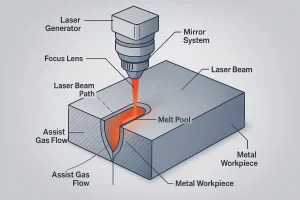
One advanced thermal cutting process is laser cutting, which utilises a highly concentrated, intense beam of light to remove material. The core principle lies in the laser generator producing a beam characterised by monochromaticity, coherence and high directivity. The beam is then focused—through factors such as the focal length—and transmitted via an optical system to converge at an extremely small focal point, thereby generating a high degree of energy density.
![图片[1]-激光切割:工艺原理、优势和工业应用-大连富泓机械有限公司](/wp-content/uploads/2026/07/1783512772281_0.webp)
A schematic diagram of the laser welding process, highlighting the beam path and the formation of the molten pool.
When the focused beam strikes the surface of the workpiece, the material rapidly absorbs energy, causing its temperature to rise instantly to above its melting point or boiling point. Depending on the material and the auxiliary gas used, the removal mechanisms are primarily categorised as follows: fusion cutting, in which an inert gas (such as nitrogen) blows the molten material away; vaporisation cutting, in which the material is directly converted into a gas and ejected; and flame/oxidising cutting, which utilises an active gas (such as oxygen) to produce an exothermic reaction, aiding melting and accelerating the cutting process. In modernindustrial applicationAmong fibre lasers and CO₂ lasers, fibre lasers are increasingly being used in metalworking due to their excellent beam quality and electrical efficiency. Precise CNC motion systems ensure that the laser spot follows the programmed path accurately, enabling high-quality contour cutting.
Core strengths
Laser cutting technology has fundamentally transformed manufacturing capabilities by delivering predictable results—which are crucial for engineering decision-making—and by offering operational efficiency; the value of this process is demonstrated by the following results-based advantages.
highly accurateand dimensional accuracy
The minute focal point of the laser beam enables extremely narrow cuts, which in turn translates directly into high geometric precision and the ability to realise complex features. As the machining process is non-contact, mechanical deformation caused by clamping or cutting forces is eliminated. This ensures excellent dimensional consistency and part integrity, which is crucial for components requiring strict assembly tolerances.
Speeding up turnaround times and improving productivity
When cutting medium-to-thin sheet metal, laser cutting is exceptionally fast and, compared to most mechanical methods, can significantly reduce the cutting cycle time for each component. Combined with high-density nesting and easily integrated automated material handling systems, this process achieves high productivity whilst minimising manual intervention. This potential for automation, combined with the high speed, reduces lead times, thereby enabling rapid turnaround for both prototyping and high-volume production.
Reducing overall production costs
The combined effect of various factors results in a reduction in total cost of ownership (Technical Cooperation Organisation). The minimal cut width maximises material utilisation, which is of particular value when working with expensive alloys. Furthermore, as the cut quality is exceptionally high, secondary processing steps such as deburring or grinding are usually unnecessary, or are significantly reduced. The simplification of the post-processing chain directly leads to lower labour and operating costs.
Flexible design, diverse manufacturing processes
Laser cutting requires no tooling and allows production changes to be implemented immediately, without delay or the need for new tools. This high degree of flexibility readily supports complex design iterations and the production of bespoke, one-off parts. The process is highly adaptable, suitable for virtually all industrial materials—from standard carbon steel to reflective copper—and supports a wide range of thicknesses, providing a single solution for diverse manufacturing requirements.
Materials and Thickness Capacity Categories | Typical Laser Types | Commonly Used Materials | Main Process Description
cooking oil
Fibre laser
Carbon steel, stainless steel, aluminium, copper alloys
This process is highly efficient; nitrogen fusion cutting ensures that there is no oxide on the edges, and the thickness can reach over 20 millimetres.
Non-metallic
CO₂ laser
Acrylic, wood, polymers, textiles, composite materials
Vaporisation/ablation cutting; thermal control is required to minimise the HAZ
Fibre lasers, with their outstanding beam quality and electrical efficiency, dominate the field of modern metal cutting, whilst CO₂ lasers remain a reliable choice for cutting non-metallic materials, as smooth edges and minimal charring are of paramount importance when cutting such materials.
A Comparison of Costs and Efficiency
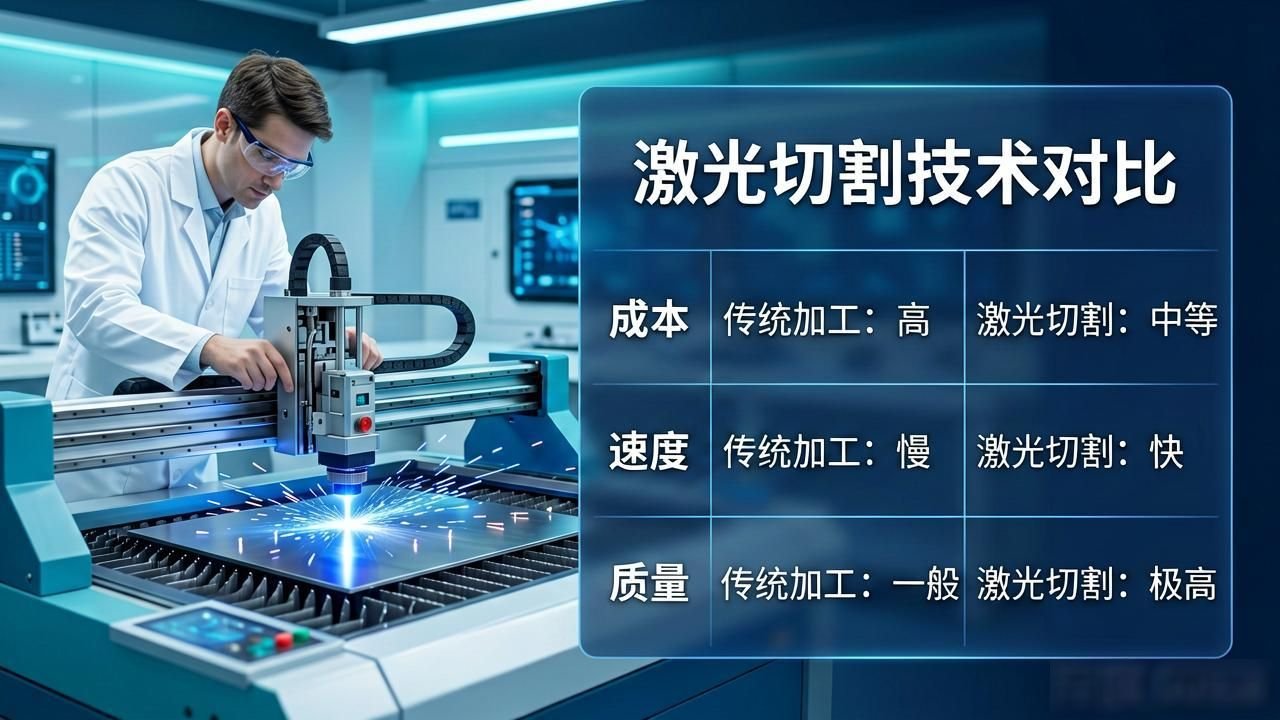
When selecting a cutting process, engineers must carry out targeted comparisons between laser cutting and other common technologies in terms of cost, speed and quality.
Compared to waterjet cutting, waterjet cutting is a cold cutting process; it eliminates the heat generated during the cutting process and the heat-affected zone (HAZ), and is suitable for all materials. However, laser cutting is much faster when cutting thin metal sheets, and its operating and maintenance costs are generally lower. Waterjet cutting offers better edge perpendicularity when cutting extremely thick workpieces, though this comes at the expense of speed and higher abrasive consumption costs.
Plasma cutting is cost-effective and offers high cutting speeds when cutting thick metal plates. In contrast, laser cutting offers advantages over plasma cutting in terms of precision and edge quality, and is suitable for smaller cutting areas. HAZ. For heavy-duty structural components with less stringent tolerance requirements, plasma cutting is the first choice, whilst laser cutting is the undisputed choice for high-precision applications involving medium- to thin-gauge materials.
For simple parts produced in large volumes, stamping is the most cost-effective method compared to CNC milling or stamping; however, it requires a significant initial investment in tooling. CNC milling can achieve the highest precision; however, due to its low material removal rate, it is relatively slow and incurs tool wear costs. Laser cutting strikes the optimal balance between flexibility, speed and precision, making it particularly suitable for prototyping, small- to medium-volume production and parts with complex geometries, thereby achieving a favourable total cost of ownership (TCO).
appliance
There is a technology known as laser cutting, which has an extremely wide range of applications. It offers a high degree of precision and is very fast, and has become a fundamental process in many mission-critical industries.
![图片[3]-激光切割:工艺原理、优势和工业应用-大连富泓机械有限公司](/wp-content/uploads/2026/07/1783512772281_3.webp)
Examples of precision laser-cut metal sheets, featuring clean edges and flexible design options.
reach a verdict
In today’s precision manufacturing sector, laser cutting is an indispensable and rapidly evolving technology that offers a highly efficient, adaptable and quality-controlled solution, enabling mechanical design engineers to achieve complex geometries, allowing manufacturing engineers to streamline production workflows, and helping procurement managers source high-value, cost-effective customised parts. It has successfully addressed key limitations associated with traditional cutting methods and has fostered a close alignment between design intent and manufacturing reality.
We can guarantee that we will manufacture your products to the best possible standard in terms of both cost and quality, based on your design, the CAD drawings you upload or your technical specifications. Our engineering team will carry out a professional review and provide an accurate quotation.


 Chinese
  Japanese
  English
  German
  Finnish
No comments