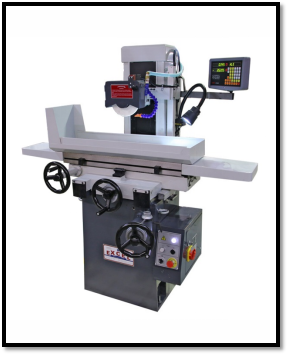


Grinding machines are used to make clean cuts and to achieve a fine finish on the metal.surface finish. These machines are generally used in manufacturing industries, especially in the automotive as well as aerospace industries, where surface finish is of utmost importance. If you are searching for articles related to grinding machines, then you have come to the right place because in this article, we will be discussing the types and specifications of grinding machines.

Figure 1: Grinding machine
What is it?Grinding?
A grinder is a tool that is used to remove excess material from surfaces and also to provide a smooth surface for metals, the process starts with a grinding wheel that is used to cut the workpiece on contact, in addition to the ability to obtain light and any desired shape depending on the application.
The main characteristics of the grinding process
Grinding machines have many useful features, but the most important ones are discussed here:
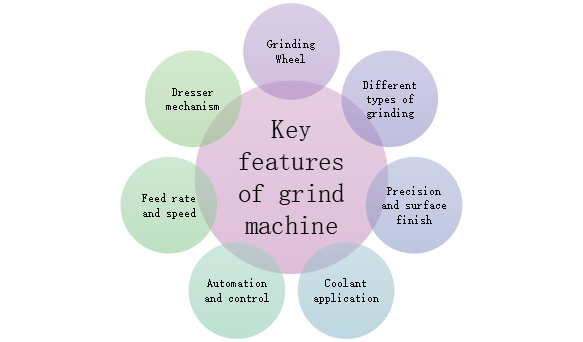
Figure 2: Key Features
How does grinding work?
The following guide will give you an idea of how this process works:
Basic grinding principle
These principles are based on the following steps:
Key factors influencing the grinding process
The table below lists the factors that may have an impact on the process of grinding, so it is important to be vigilant in order to be able to operate effectively:
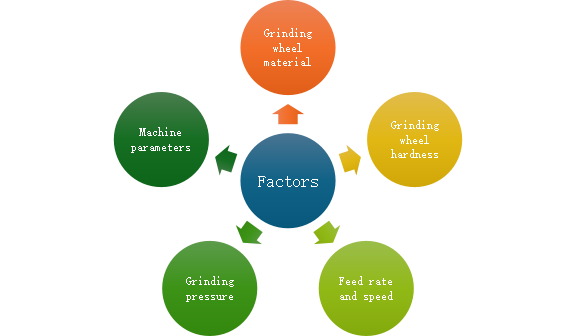
Figure 3: Factors
Commonly Used Grinding Machines
These are commonly used grinding machines in different industries. The following are some of them:
Advantages and disadvantages of grinding
This section discusses the significant advantages and disadvantages of using a grinder.
Advantages of grinding in precision manufacturing
Disadvantages and limitations of grinding
When to choose grinding over other machining processes
All of this depends on the type of material and the application, however the general criteria is that if the material removal rate (MRR) is low then the machine is preferred, if the workpiece is small and needs a clean and precise surface finish then use a grinder rather than another machine.
Grinding applications
The main grinding applications are as follows:
Types of grinding processes
The following sections discuss the major types of processes performed on grinding machines:
plane grinding
In this function, the grinding wheel maintains contact with the workpiece. Operating speeds are generally in the range of 28 to 33 metres per second, with an MRR of 1 cubic inch per second, which is a key technical characteristic of these wheels.
Cylindrical grinding
Cylindrical grinding is used for cylindrical parts that require tight tolerances, and in this type of grinding the operating speed is between 25 and 33 metres per second, with an MRR of 1 cubic inch per second.
Mindless grinding
In this machine, the working blade has only one function, which is to support the workpiece during grinding. Due to its centreless geometry, it is often used for cylindrical parts and objects. Its speed is 23 to 30 metres per second while maintaining an MMR of 1 inch per second.
Internal cylindrical grinding
As the name suggests, it is used on the internal parts of the components, and the samples can be ground with the help of its utility. Some of the common examples that exist cover internal holes as well as tubes. The machine operates at speeds in the range of 33 to 48 metres per second, with an MRR of 0.5 to 1 cubic inch per second.
Slow feed grinding
This grinding machine helps you to achieve complex machining in the shortest possible time, a feature that makes it suitable for the aerospace industry, i.e. high-strength alloys, with a typical operating speed of 0.10 m/s. The grinding machine can be used for a wide range of applications, including the aerospace industry and the aerospace industry.
Contour grinding
If high precision is required, a profile grinder can be used, and several operators have said so, with the machine running at speeds in the range of 20 to 25 m/s, and with an MRR of 30 in³ at 1s intervals.
666
What materials can be used in the grinding process?
The materials that can be processed by grinding machines are varied and include steel alloys, aluminium and aluminium alloys, as well as titanium, etc. It is important to understand that ceramics are difficult to process with the aid of the grinding process, however, the final situation depends on the application.
Grinding technology
Given below are some of the important technical details of grinding that you should know:
Grinding Wheel Specifications
The following table outlines the technical specifications required for grinding wheels:
Table 1: Specifications
Abrasives in grinding wheels
Here are the abrasive materials you will often see in grinding wheels:
Speed, feed and depth of cut in grinding
Speed, which refers to the kind of speed at which the wheel carries out its rotational action, is calculated in RPM, or revolutions per minute.
The feed rate, which is used to indicate the rate at which the grinding wheel moves towards the workpiece, is expressed in mm/min and ipm.
Depth of cut:
Key considerations for grinding tool steels
Once you are in a situation where you are using grinding tool steel, it is important that you take the following measures, otherwise you are likely to incur serious problems. These measures cover:
Selection of the appropriate grinding wheel based on the workpiece material, selection of the appropriate coolant to control the heat generated by the cut, application of the appropriate average grain size, application of the optimum parameters, i.e. speed and feed rate.
What is the difference between milling and grinding?
Single cutting tools or multiple cutting tools are used in the milling process and this operation has a high MRR, however the surface finish is low.
In the case of grinding, the process is carried out with only a single wheel, and this process has a corresponding material removal rate that is lower than that of milling, but the surface finish is higher than that obtained by milling in this process, is this the case, right?



 Chinese
  Japanese
  English
  German
  Finnish
No comments