

Being in the modern worldmachiningIn this category, if we talk about machine tools as the core equipment, then the stability of its performance is extremely important. However, the machine tool in its operation throughout the process, is often vibration this situation. After this vibration, it will not only have an impact on the machining accuracy and surface quality, but there is also the possibility of damage to the tool, resulting in reduced productivity, such a situation will even pose a threat to the health of the operator. Therefore, in-depth to understand the machine vibration involves the mechanism, the reason behind, and take effective measures to prevent and control, which has great practical significance.
First, the machine tool vibration mechanism
(i) Forced vibration
Forced vibration is caused by stable external periodic disturbing forces. Other machine tools, forging hammers, trains, trucks, etc., outside the machine transfer vibrations to the machine through the foundation. Machine rotary parts quality imbalance, machine tool transmission parts there are manufacturing errors and defects, cutting process impact, etc., these conditions, will also produce forced vibration.
The frequency is the same as, or an integral multiple of, the frequency of the disturbing force, which is one of the characteristics of forced vibration, and the amplitude is related to the amplitude of the disturbing force and to the dynamic characteristics of the process system, and the phase angle characteristic of a change in the displacement of the forced vibration is that it passes the disturbing force by an angle in phase.
(ii) Self-excited vibrations
Self-excited vibration is a kind of periodic vibration, it is not in the case of periodic external force, but in the absence of periodic external force, by the internal excitation of the system feedback formation, in the cutting process, the process itself can trigger some kind of alternating cutting force, and the vibration system can be from the change of the force to obtain supplementary energy, and then maintain the vibration.
Self-excited vibration has some of these characteristics, one, there is no interference from periodic external forces, two, its frequency is close to one of the intrinsic frequencies of the system, three, it does not decay, four, the vibration is determined by the parameters of the vibrating system itself, and five, it also depends on the state of the system in terms of the contrast between the energy gained and energy consumed in each cycle.
Second, the causes of machine tool vibration
(i) Motor and mechanical factors
1. Motor problems
The magnetic poles of the motor are permanent magnets, and in the course of their movement, small fluctuations occur due to the phenomenon of hysteresis, or because of static friction on the mechanical side, as well as low-frequency vibrations caused by the lack of rigidity of the machinery. In the case of linear motors, parameters can be used to compensate for hysteresis-induced vibrations.
2. Problems with transmission components
Grinding wheels rotating at high speeds are unbalanced, pulleys rotating at high speeds are unbalanced, etc., the thickness of the belt varies, the length of the belt is inconsistent, and the oil pump is unstable, etc., which can lead to forced vibration of the machine tool. Gear drive is not stable, belt drive is not stable, chain drive is not stable, etc., these transmission equipment is not stable will also cause vibration.
(ii) Parameterisation issues
1. Mismatch between position and velocity loop gains
can induce low frequency vibrations, usually by first boosting the gain of the velocity loop and later reducing the gain of the position loop.
2. Command vibration

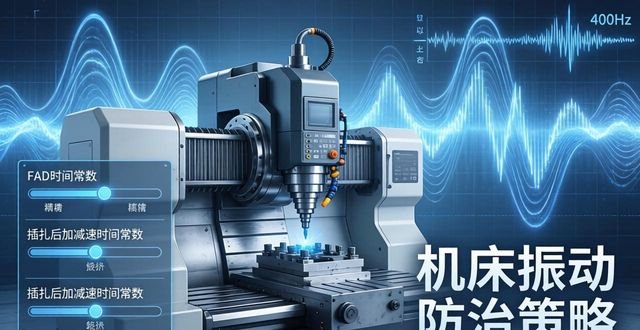
The interpolation period of the instruction is 8ms. When the speed gain is increased, the signal may vibrate, and when the position gain is increased, the signal may also vibrate, or vibrate higher than 400HZ due to the effect of VFF. The vibration can be eliminated by adjusting the FAD time constant, or by adjusting the acceleration/deceleration time constant after interpolation, or by appropriately reducing the VFF setting value.
(iii) Full closed-loop control issues
In the case of a system with fully closed-loop control, poor rigidity of the mechanical connections can lead to vibration during movement, especially during acceleration and deceleration. The key is the inconsistency between the position feedback on the mechanical side and the speed feedback on the motor side. This can be resolved by adding mechanical speed feedback, adding vibration suppression control, and implementing dual position feedback, but the results may not be satisfactory.
(iv) Special circumstances
In the case of a falling gravity axis, vibration occurs as a result of the energy feedback to the motor and then to the amplifier; on the shaft, external vibration occurs as a result of the difference in speed and load characteristics of the two connected motors.
Third, the machine tool vibration prevention and control measures
(i) Measures against forced vibration
1. Reduction of excitation forces
Balancing operations are carried out on parts with high rotational speeds to improve the smoothness of the transmission equipment, and reasonable measures are taken to reduce the speed of machining operations and to separate the main part of the machine for machining from the power part.
2. Adjustment of vibration source frequency
Avoid the frequency of the excitation force, and the system resonance frequency is the same, and thus produce resonance, in the machining process, to reasonably select the rotational speed.
3. Improvement of mechanical process stiffness and damping
Flexible couplings are used to isolate motor vibrations, to separate the hydraulic section from the machine tool, to use hydraulic cushioning devices, to isolate the machine tool from the ground with the help of vibration isolation objects, etc.
4. Introduction of vibration isolation measures
Firstly, isolate the machine from the source of vibration, with the help of fairly flexible vibration isolation equipment, such as isolating the hydraulic section from the machine, adding cushioning, isolating with rubber mats, etc., and placing vibration damping devices in the process system.
5. Improving the stability of lifting devices
Belts and joints should be improved, more use of the belt, and as far as possible to reach a uniform state, the use of helical gears or herringbone gears to replace the spur gears, moderate adjustment of the belt tension, but also a reasonable selection of the appropriate length.
(ii) Self-excited vibration protection measures
1. Reasonable selection of tool geometry and cutting volume
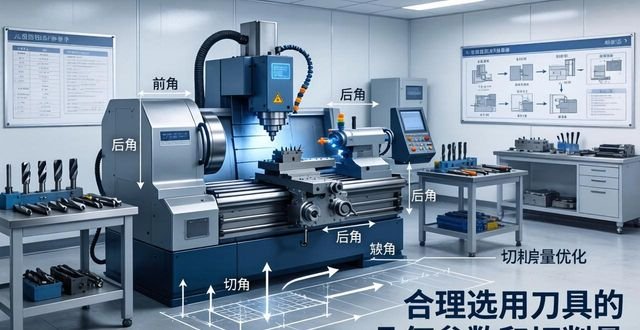
The cutting speed should be chosen within a certain range, with a relatively small depth of cut and a relatively large amount of volume, in order to reduce the self-excited vibration. The experimental and theoretical studies can show that the main deflection angle and the front angle of the tool is the main geometric parameter that affects the vibration.
2. Improving the vibration resistance of process systems
Improve the contact stiffness of the process system by scraping the contact surfaces, reducing the spindle system bearing clearance, applying preload to the rolling bearings, and improving the grinding quality of the centre bore. Boring bar and tool overhangs are reduced by the use of centre stands or followers, dead centres are replaced by live centres, and flexible toolholders are used.
3. Introduction of vibration dampening devices
Damping devices are used to absorb or dissipate the energy generated by vibration to reduce forced vibration and tremor when other methods of damping are not effective, but they do not increase the stiffness of the process system.
4. Adjustment of the stiffness ratio of the vibration pattern
According to the principle of vibration mode coupling, the stiffness ratio of each vibration mode is reasonably adjusted, and the combination is adjusted to improve the vibration resistance of the system and to suppress self-excited vibration.
(iii) Other integrated prevention and control measures
1. Elimination or attenuation of conditions that produce forced vibration
By reducing the value of the disturbing force in the machine, adjusting the frequency of the vibration source, adopting vibration isolation measures, improving the rigidity of the process system plus damping, and applying vibration damping devices.
2. Elimination or attenuation of conditions that give rise to self-excited vibrations
Reduce the overlap coefficient at the time of cutting or grinding, properly select the cutting dosage and tool parameters, adjust the position of the small stiffness spindle of the vibration system, increase the cutting damping, and use variable speed machining.
3. Improvement of process system dynamics
Improve process system stiffness and increase process system damping.
In short, machine tool vibration this situation, is a complex problem, from multiple levels to analyse and prevent. In-depth knowledge of the mechanism and causes of vibration, the use of effective prevention and control methods to enhance the machining accuracy and stability of the machine tool, to extend the life of the tool and equipment, improve productivity, to the development of the machining industry to be a strong guarantee.



 Chinese
  Japanese
  English
  German
  Finnish
No comments