


Steel plates of various thicknessesWelding processThe Complete Guide to Parameter Selection
In the field of metalworking, the thickness of steel plates is a key factor that plays a central role in determining the specific parameters of welding processes. Differences in thickness have a direct impact on heat input, penetration requirements anddeformation controlThe strategies adopted have a significant impact. Selecting the appropriate process parameters is a key prerequisite for ensuring welding quality and enhancing production efficiency.
Thin-sheet welding: precise heat control to prevent distortion
For thin steel plates less than 3 millimetres thick, the greatest challenges encountered during welding are burn-through and distortion; heat input must therefore be precisely controlled.
When selecting a welding method, gas shielded arc welding or TIG welding are the first choices, as both methods produce a small heat-affected zone and feature a concentrated arc. For ultra-thin sheets with a thickness of less than 1 millimetre, pulsed TIG welding yields the most ideal results.
The key parameter for welding current is to maintain it within the range of 40 to 100 amps; the thinner the material, the closer the current should be to the lower limit of this range. the arc voltage should be maintained at a low level, approximately 12 to 16 volts; the welding speed should be increased appropriately to prevent heat build-up; and the shielding gas flow rate should be maintained at 6 to 10 litres per minute.
In terms of key technical points, the welding method should involve intermittent welding or spot welding, proceeding from the centre towards both ends; this effectively disperses the heat. When joining thin plates, there should be no gap, or only an extremely small one. In such cases, copper shims must be used to aid heat dissipation, thereby reducing the risk of burn-through on the reverse side.

Welding of medium- and heavy-gauge plates: Balancing penetration and efficiency
The thickness of the steel plates ranges from 3 to 20 millimetres, which falls within the scope of the most common welding applications. In such cases, it is necessary to strike a balance between penetration depth and production efficiency.
In terms of welding methods, submerged arc automatic welding and CO₂ gas shielded welding are the mainstream choices, whilst multi-layer, multi-pass welding techniques have also begun to be adopted.
Key parameter settings: for the root pass, the welding current should be maintained between 120 and 180 amps; for the fill and cover passes, it should be increased to between 180 and 280 amps. The arc voltage should be adjusted accordingly to between 22 and 32 volts. The welding speed should be maintained at 25 to 45 centimetres per minute. The groove type should be selected as a V-groove or single-sided V-groove depending on the plate thickness, with a root face height of 1 to 2 millimetres.
The key points of the operating procedure are as follows: when the plate thickness exceeds 10 millimetres, beveling must be carried out; Interpass temperatures must be maintained within the range of 150 to 200 degrees Celsius to prevent excessive heat from causing grain coarsening. The cleaning of each weld pass is of critical importance, particularly when using gas shielded welding, as the removal of spatter is essential. For steel plates thicker than 12 millimetres, it is recommended to use a double-sided welding process. First, weld one-third of the front side; once the root pass on the reverse side has been completed, proceed to finish the remaining welding work.
Thick-plate welding: multi-pass and multi-layer welding, and preheating and slow cooling
Thick steel plates, with a thickness exceeding 20 millimetres, present a systematic and complex challenge when it comes to welding. The key dilemma lies in the fact that, on the one hand, the need to ensure full penetration, and on the other, the need to prevent cold cracks and laminar tearing.

When selecting welding methods: Submerged arc welding is the predominant method; electroslag welding is suitable for straight-seam welding of plates 50 mm thick or more; and gas-shielded welding is used for root passes and in difficult positions.
Key parameter settings: the base pass current should be set within the range of 200 to 250 amps; the fill pass current can be increased to a range of 300 to 450 amps, the voltage should be increased accordingly to between 30 and 38 volts. The welding speed should be reduced to between 20 and 35 centimetres per minute to ensure adequate fusion. The wire diameter is typically selected as 3.2 or 4.0 millimetres.
Among the key process methods for thick-plate welding, preheating is a crucial lifeline; Based on carbon equivalent calculations, the preheating temperature is generally within the range of 100–200 degrees Celsius. The interpass temperature must be maintained at a level no lower than the preheating temperature, but must not exceed 250 degrees Celsius. Post-weld heat treatment for hydrogen removal is equally important; immediately after welding is completed, the material must be heated to 200–300 °C and held at this temperature for 2–4 hours.
The groove type and number of passes must be planned; for thick plates, a double-sided U-groove or X-groove must be used to minimise the amount of filler metal required. When performing multi-pass welding, the thickness of each pass should be controlled between 3 and 5 millimetres, and the width of each pass should not exceed eight times the diameter of the welding wire. A symmetrical welding sequence must be adopted, with the steel plate being turned over after each pass; this is the most effective method for controlling angular distortion in thick plates.
Process adjustment strategies for special thicknesses

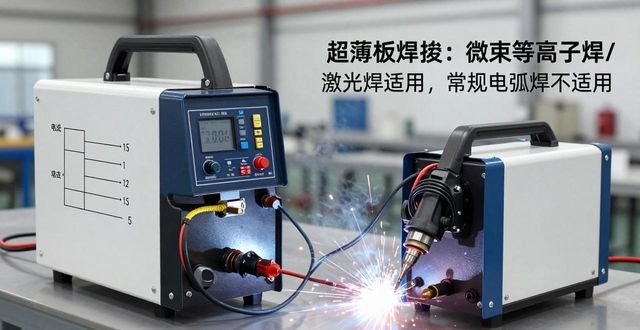
For ultra-thin sheets, where the thickness is 0.5 mm or less, it is recommended to use micro-beam plasma welding or laser welding for the welding operation. Conventional arc welding is no longer suitable in such cases; it is essential to use a power-frequency inverter welder, as this type of welder has a fast current response and is capable of delivering a stable low-current output.
For extra-thick plates, where the thickness exceeds 100 millimetres, single-wire submerged arc welding is not sufficiently efficient. Dual-wire or multi-wire submerged arc welding must be employed, with the front wire ensuring penetration depth and the rear wire improving bead formation. At this stage, the heat input can reach over 50 kilojoules per centimetre. With regard to the welding sequence, the step-back welding method is employed, whereby the long weld is divided into several short sections and welded sequentially, thereby effectively controlling longitudinal shrinkage stresses.
The core logic of parameter selection
Regardless of the thickness of the steel plate, the underlying logic for selecting parameters remains the same: the heat input is equal to the current multiplied by the voltage and then divided by the welding speed. Thin steel plates require low heat input, whilst thick steel plates require high heat input; however, this must be accompanied by preheating and slow cooling.
One parameter is the dry extension, which is the sort of parameter that is easily overlooked. When welding thin plates, the dry extension length should be maintained within the range of 8 to 12 millimetres, whereas when welding thick plates, the dry extension length can be extended to 15 to 25 millimetres. A greater dry extension length generates a resistive heating effect, which is equivalent to preheating the welding wire, thereby improving deposition efficiency.
When welding thin plates, it is important to use a DC reverse polarity current, as this produces a stable arc and minimises spatter. For thick plate welding, both DC and AC current types are suitable; however, AC submerged arc welding offers particular advantages in welding plates thicker than 50 mm, as it helps regulate arc blow to promote penetration.
reach a verdict
The selection of welding parameters for steel plates of different thicknesses is, in essence, a unique art form centred on heat balance. For thin plates, heat must be carefully controlled to prevent deformation, whilst for medium and thick plates, the focus is on penetration depth and efficiency; for thick plates, the emphasis is on preheating and slow cooling. In the practical welding process, one should first determine the welding method and groove configuration based on the plate thickness, then calculate the appropriate range of current and voltage using heat input formulas, and finally verify and adjust the settings using test plates.
Keep in mind a practical rule of thumb: for every doubling of thickness, the heat input must be increased by approximately 50 per cent. Taking 15 kJ per centimetre for a 3-millimetre steel plate as a benchmark, a 12-millimetre steel plate should require at least 45 kJ per centimetre. At the same time, the preheating temperature increases with thickness, rising by 15 to 20 degrees Celsius for every 10 mm of thickness. By understanding these principles, you will be able to quickly determine appropriate parameter settings for welding steel plates of any thickness.



 Chinese
  Japanese
  English
  German
  Finnish
No comments