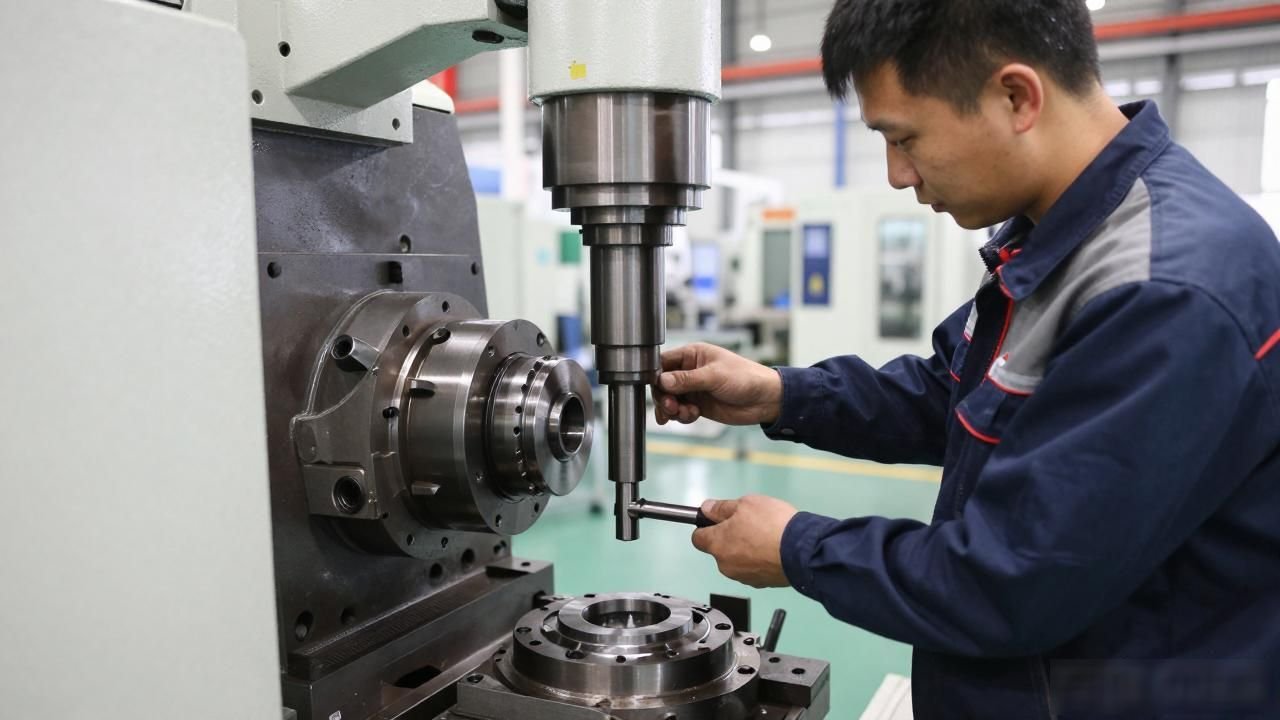


Technical Grades for Boring OperatorsStandards
I. Definition of the profession
Operate a boring machine to machine workpieces in accordance with technical specificationsworking (of machinery).
II. Scope of Application
Operation, adjustment and maintenance of various boring units.
III. Technical Grade Thresholds
Primary, lower secondary and upper secondary levels
Junior Boring Operator
I. Knowledge Requirements
1. The name, model, specifications, performance, structure and transmission system of the equipment for own use.
2. Lubrication systems, operating procedures and maintenance methods for equipment used in-house.
3. The names, specifications, purposes, operating procedures and maintenance methods for tools, jigs and gauges (instruments) used in day-to-day operations.
4. In terms of type, grade, specifications and performance, what are the commonly used cutting tools? How do the geometric parameters of cutting tools affect cutting performance? How can cutting parameters be selected appropriately to extend tool life?
5. The categories, designation numbers and mechanical properties of common metallic materials; their behaviour during machining; and knowledge of thermal expansion during the machining process.
6. Types and uses of commonly used lubricants.
7. Types and uses of commonly used cutting fluids, and their effect on surface roughness.
8. Commonly used mathematical calculations.
9. Basic knowledge of metal heat treatment.
10. Basic knowledge of mechanical drawing, tolerances and fits, geometric and positional tolerances, and surface roughness.
11. Basic knowledge of mechanical transmission.
12. Basic knowledge of fittery.
13. General technical knowledge of relevant trades.
14. Basic knowledge of face milling and up-milling.
15. General knowledge of electrical appliances for domestic use, and safety guidelines for using electricity.
16. Analyse the causes of scrap and the preventive measures.
17. Safety Technical Regulations.
II. Skills Required
1. Correct operation and maintenance of equipment used for personal purposes, and the ability to identify common machine tool faults in a timely manner.
2. Be able to apply appropriate techniques when using common tools, fixtures, gauges and cutting tools; carry out proper maintenance and upkeep; and be able to sharpen standard cutting tools.
3. Be able to read parts drawings and follow manufacturing procedures correctly.
4. Basic fitter’s skills.
5. Use standard and modular clamping devices correctly.
6. When boring parts with multiple holes on the same plane or on intersecting planes, calculate the coordinate dimensions whilst adjusting the machine tool accordingly.
7. Boring various stepped holes, blind holes, countersinks and eccentric oil grooves.
Page 1
8. Be able to determine whether the machine tool is operating normally, based on the quality of the workpiece and the machine’s operating conditions.
9. Use a micrometre to adjust the measuring bore of the internal caliper to an accuracy of 0.05 mm.
10. Correctly follow safety and technical operating procedures.
11. Comply with the requirements of the post responsibility system and those relating to safe and orderly production.
III. Practical Examples
1. First, carry out rough machining of parts with multiple holes or varying hole spacings on various types of boring machines, leaving an allowance of up to 1.5 mm at each hole for finish boring; the permissible error in hole spacing must comply with the requirements specified in the process, and the surface roughness must be Ra 3.2 μm.
2. Rough bore a hole with a diameter of 100 mm, with a depth of 250 mm, to a tolerance grade of IT7 and a surface roughness of Ra 3.2 μm, followed by finish boring of the hole to a tolerance grade of IT7 and a surface roughness of Ra 3.2 μm.
3. Bore two faces, which are perpendicular to each other, and mill two faces, which are parallel to each other. For these two sets of faces, the positional accuracy requirement is 0.05 mm/300 mm, and the surface roughness is Ra 1.6 μm.
4. Bore various medium-sized connecting rod holes, bracket holes or support holes in accordance with the drawings and process requirements.
5. Using boring jigs, specialised tooling and combination fixtures, rough boring operations are carried out on various holes in the housings; this process is in line with the technical requirements.
6. Using a co-ordinate boring machine, boring and milling operations are carried out on an outer diameter greater than 60 mm to produce a symmetrical keyway. The tolerance grade is set at IT9, and the error in symmetry of the keyway relative to the axis is no greater than 0.05 mm.
7. Using a coordinate boring machine with a single-cutting-head tool, bore a hole with a diameter of 18 mm and a length of 40 mm or more, with a tolerance grade of IT7 and a surface roughness of Ra 1.6 μm.
8. Bore and mill the various holes and end faces of the multi-axis gearbox in accordance with the drawing specifications.
9. By rotating the disc to perform flat turning operations, the resulting flatness error does not exceed 0.05 mm per 300 mm, whilst the corresponding surface roughness is as follows.
Ra 3.2 m.
Intermediate Boring Operator
I. Knowledge Requirements
1. The performance, structure, drive systems and adjustment methods of commonly used boring machines.
2. The names, purposes, methods of use and maintenance of commonly used measuring instruments.
3. Commonly used tools and fixtures, including modular fixtures, their construction, methods of use, adjustment procedures and maintenance practices.
4. Basic knowledge of the preparation of process specifications.
5. Principles of metal cutting and basic knowledge of cutting tools.
6. Methods and measures to prevent workpiece deformation during machining.
7. The impact of machine tool accuracy on workpiece accuracy, including methods for improving workpiece machining accuracy and for reducing surface roughness.
8. Methods for calculating hole spacing and tolerances in various complex, porous workpieces.
9. The application of digital display units on boring machines.
10. Basic knowledge of hydraulic transmission.
11. Knowledge of production technology management.
II. Skills Required
1. Prevent and rectify common faults in the in-house boring machine.
2. Be able to interpret relatively complex part drawings and general assembly drawings, and draw general part drawings.
3. Depending on the machining requirements of the workpiece, grind various non-standard cutting tools, dress reamers, and subsequently dress floating boring tools.
4. Draw up general process specifications and establish a process sequence in accordance with the technical requirements of the workpiece
5. Clamping of irregularly shaped and extra-large workpieces.
Page 2
6. Machining of deep-bore workpieces.
7. Precision boring of box-type and multi-bore-spaced components.
8. Boring and adjustment using multiple tools with multiple cutting edges.
9. Boring and clamping various types of precision or thin-walled workpieces.
10. Use a sliding table to machine various flat surfaces, internal bores and external cylindrical surfaces.
11. Be able to interpret some schematic diagrams illustrating the principles of hydraulic and electrical power transmission.
III. Practical Examples
1. The gear pump housing is machined by boring; its tolerance class is IT6, and the surface roughness is Ra 1.6 μm.
2. Precision boring of workpieces with various numbers of holes, each having three or more holes, with a tolerance class of IT7 and a surface roughness of Ra 1.6 μm.

3. Rough and finish boring operations were carried out on thin-walled bores with a diameter of 150H7 or greater; the wall thickness of these bores was less than 10 mm, and the final result met the requirements specified in the drawings.
4. First, use a rotating disc to turn the outer diameter, then turn the end face, followed by turning the inner bore; the tolerance grade is IT7, the surface roughness is Ra 1.6 μm, and the accuracy requirements must comply with the drawing.
5. Using boring jigs, specialised tools and combination fixtures, precisely bore various holes in housings, including multi-sided holes and holes with varying centre distances, to ensure they comply with the technical requirements specified in the drawings.
6. Using a single-flute cutter, for diameters of 20 mm or less—that is, less than 20 mm—precision bore a 50 mm-long blind hole with a tolerance grade of IT5 and a surface roughness of Ra 1.6 μm.
7. A slender bore with a diameter-to-length ratio of 1:6 is machined using rough boring, followed by finish boring; the resulting tolerance grade is IT7, with a surface roughness of Ra 1.6 μm.
8. With reference to the above examples, carry out machining using a coordinate boring machine, followed by machining on a CNC boring machine, thereby appropriately improving accuracy and surface finish.
9. Machining of workpieces of a corresponding level of complexity.
Senior Boring Operator
I. Knowledge requirements:
1. Methods for checking the accuracy of commonly used boring machines.
2. The operating principles and applications of various precision measuring instruments.
3. The operating principles of commonly used clamping mechanisms, clamping elements and general clamping force calculations.
4. The principles and applications of the various mechanisms of a boring machine.
5. Select reference planes for various types of complex workpieces and draw up comprehensive process specifications.
6. Knowledge of machining processes.
7. Knowledge of CNC boring machines.
8. Machining and measurement methods for high-difficulty, precision workpieces.
9. Knowledge of hydraulic transmission and the electrical control systems of machine tools.
10. Basic knowledge of productivity improvement.
II. Skill Requirements:
1. Carry out accuracy checks and adjustments on various boring machines in accordance with the machine tool manuals.
2. Refine the workpiece, fixtures and moulds, and draw a structural sketch.
3. Resolve various technical issues relating to the operation of boring machines.
4. When dealing with complex, highly challenging and precision workpieces, it is necessary to propose reasonable and cost-effective manufacturing processes, and to draw up comprehensive plans.
Process Specifications.
5. Programming and inputting programmes for CNC boring machines and boring-milling machines.
Page 3
6. Precision boring of various types of precision and complex box-shaped workpieces.
7. Draw up process specifications.
8. Apply and promote new technologies, processes, equipment and materials.
III. Practical Examples
1. Boring of various types of multi-hole workpieces with extremely high precision; ‘multi-hole’ refers to three or more holes. The tolerance grade used is IT5, and the surface roughness is Ra 0.8 μm. A requirement has been specified for hole spacing accuracy, which must not exceed 0.02 mm.
2. Boring, turning and scraping of mutually perpendicular surfaces; scraping of mutually parallel surfaces; scraping of two or more surfaces; the precision requirement for the surfaces is within 0.008 mm, and the surface roughness is Ra 0.8 μm.
3. In the context of new product prototyping—where there are no boring jigs, no specialised tooling and no combination fixtures—the machining of various complex holes in housings has yielded results that comply with both the drawing specifications and the process requirements.
4. Machining large flat surfaces that are not in the same plane, as well as machining housings, frames or large workpieces featuring grooves, steps and holes, to ensure they comply with the standards specified in the drawings.
5. Various types of coordinate boring operations; refer to the examples above and appropriately increase the precision requirements.
6. Machine precision workpieces on various types of precision equipment, whilst also machining workpieces made from special materials, ensuring compliance with both the drawing specifications and the process requirements.
Machining of workpieces of corresponding complexity.
Page 4


 Chinese
  Japanese
  English
  German
  Finnish
No comments