

Stress relief treatment after welding:
1, the overall heat treatment need to know, the degree of stress relief is mainly by the composition of the material, but also by the organisation, or by the heating temperature, also by the holding time. In addition, for mild steel and some low alloy steel welded components, when in the case of 650 degrees, after 20 to 40h of insulation, so that, will be able to eliminate all the residual stress.
There is also explosive stress relieving.
2. Local heat treatment: stress relief treatment after large-scale welding:
1, the overall heat treatment: the degree of stress relief is mainly determined by the composition of the material, organisation, heating temperature and holding time. Low carbon steel and some low alloy steel welded components at 650 degrees, insulation 20 ~ 40h, can basically eliminate all residual stress.
There is also explosive stress relieving.
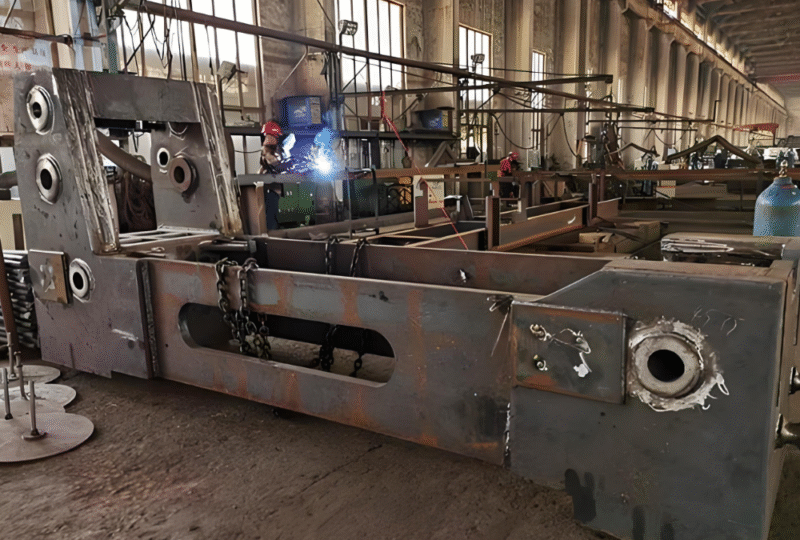
2, large welded structures, in the limitations of the heating furnace, or when the requirements are not high, will use local heat treatment method, this method can be used flame, infrared, resistance, induction and other heating methods, and to maintain uniform heating, but also with a certain width of the heating, for low alloy high-strength steel, generally in the weld on both sides of the 100 ~ 200mm.
3, on the mechanical stretching, hydraulic test, temperature difference stretching, vibration method, etc. These methods, it can only eliminate twenty to fifty per cent of the residual stress, of which, the first two methods in the production is widely used.
After welding to carry out stress relief treatment, including natural aging treatment, this way a long time, de-stressing is not complete; vibration aging, its efficiency is very high, the cost is low, but can only be removed about seventy per cent of the weld stress; in addition, there are artificial heating aging, this way a shorter period of time but the cost is high, can be removed from 100 per cent of the weld stress, but also at the same time de-hydrogenation treatment.
The use of large fuel annealing furnace, the welding of the annealing process, the use of multi-point heating, as well as multi-point temperature control, temperature control with the help of thermocouple automatic control instrumentation to control the heating, so that the temperature of each part of the furnace can be uniformly controlled in the annealing temperature required to ensure that the annealing effect of the workpiece, and at the same time also be able to remove the weld in the process of welding infiltration to the weld in the H-atom This eliminates hydrogen embrittlement of the weldment.
In the process of hot and cold machining, residual stresses will be generated, the higher value is near the yield limit; most of the residual stresses in the components show great harmful effects, such as reducing the actual strength of components, lowering the fatigue limit, and triggering stress corrosion and brittle fracture; and due to the relaxation of the residual stresses, resulting in the parts appearing to warp, which greatly affects the dimensional accuracy of the components; therefore, it is very necessary to reduce the residual stresses in the components.
There are traditional aging methods, which are heat aging, vibration aging, natural aging, static overload aging, and thermal shock aging. The latter two methods have fewer applications and are not introduced here.
Natural state resting, also known as NSR, is to leave the workpiece in the open air for a long time, generally up to six months to a year or so, with the help of seasonal variations in ambient temperature and the time effect, so that the release of residual stresses in the formation of overload conditions of temperature stresses to promote the relaxation of residual stresses, which in turn stabilises the dimensional accuracy. Because the cycle is too long, and covers a large area, only for long-term single-species mass production, and the effect is not ideal, so the current application is less.
Thermal ageing, also known as TSR, is to start the component from room temperature, or in a state not higher than 150 ^, slowly and uniformly heated, has been heated to about 550r, and then held for 4 to 8 hours, and then strictly control the rate of cooling, so that it drops to 150r below the out of the furnace, so as to achieve the purpose of eliminating the residual stresses, and thus can ensure the machining accuracy, but also to prevent the cracks Generate.
Vibration aging, also known as vibration stress relief method this way, it will put the workpiece, such as castings, forgings, welded components, etc., placed in the condition of its inherent frequency, to carry out a few minutes to dozens of minutes of vibration treatment, through the vibration of the form of the workpiece to the additional stress imposed on the additional stress and the residual stress superimposed on the material when it reaches or exceeds the yield limit of the time.


 Chinese
  Japanese
  English
  German
  Finnish
No comments