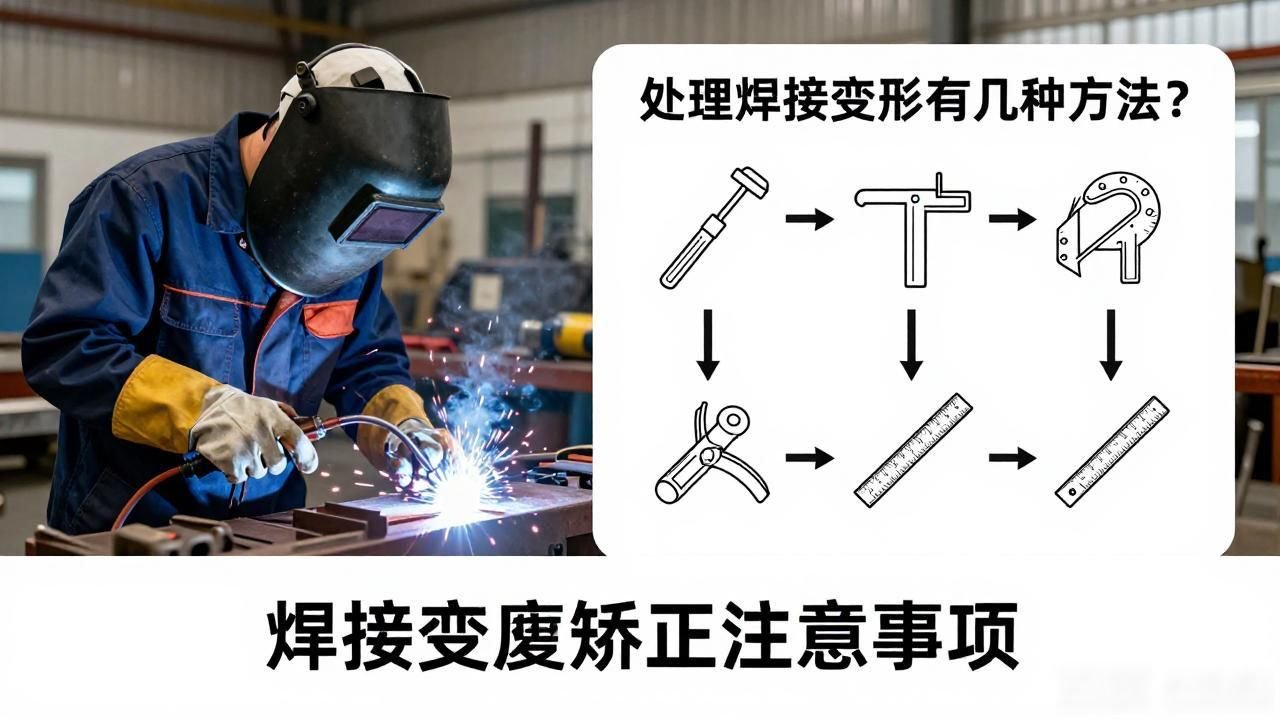


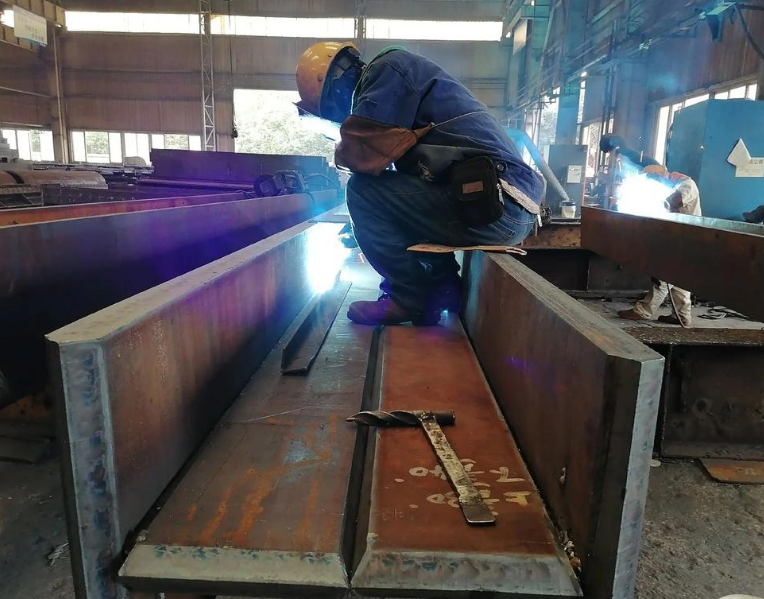
For standard welded components, deformation does not usually require correction; correction is only carried out when the deformation resulting from welding exceeds specific technical requirements;Welding distortionThis is primarily caused by shrinkage at the welded joint; the essence of straightening lies in inducing a new deformation to counteract the deformation that has already occurred; the methods used for straightening mainly comprise mechanical and thermal methods.
Mechanical correction method
1. When forging (hammering) by hand, a hammer is used to manually strike the welded workpiece to cause it to deform. To prevent damaging the workpiece, it is usually necessary to place a metal pad (preferably made of a soft metal) underneath it; this is the simplest method of correction.
2. In the case of thin-walled welded components, if rolling equipment such as a levelling machine is available, this can be used to roll the weld and its surrounding area in order to achieve the desired correction; If such equipment is not available, it is also possible, depending on the circumstances, to carry out wheel rolling using heavy vehicles on site, such as lorries or forklift trucks.
3. For simple welded components of small to medium size, correction can be carried out using a jack; both hydraulic and screw-type jacks are suitable for this purpose.
4. For welded components with high rigidity and high strength, a press may be used for straightening; the presses referred to here include hydraulic presses, hydro-static presses and pneumatic presses.
5. Profiles can be straightened using specialised straightening equipment (such as roll straighteners).
Heat-straightening method
The primary heat source in the heat treatment straightening method is flame heating. The main factors determining the effectiveness of heat treatment straightening include the heating position, the heating temperature and the shape of the heating zone; the key to success lies in the correct selection of the heating position. For simple components, the heating position is generally determined based on experience; for complex components, repeated testing is required to identify the optimal heating position. The heating temperature is usually assessed by visual inspection, although commercially available thermometers may also be used for measurement. The heating temperature generally does not exceed 800 °C (cherry red).
7. Spot heating refers to the process of concentrating heat on a single point on a metal surface; the diameter of this spot is approximately 10 to 20 mm, with a distance of 50 to 150 mm between each spot. Typically, immediately after heating a spot, the heated area is tapped with a soft hammer. When tapping thin sheets, a metal pad should be placed on the reverse side, and the area should be cooled with water (wiping with a damp cloth is also acceptable), This method is primarily suitable for correcting wave-like distortions in thin sheets.
8. Strip heating involves heating the surface of the workpiece to form a strip-like pattern, whereby the width and density of the strips are determined by the amount of deformation. This method is suitable for thick plates, situations involving significant deformation, and structures with high rigidity, such as beams and columns.
9. Triangular heating (wedge heating): The heating zone forms a triangle, with the contraction at the base of the triangle being significantly greater than that at the apex. This method is suitable for components with high rigidity and significant deformation, such as those subject to bending deformation.
10. Spot heating, strip heating and triangular heating can be applied organically and flexibly; in the context of straightening work, this can achieve twice the result with half the effort.
Overall heating is suitable for situations involving large quantities of small workpieces. In such cases, this method should be considered, followed by mechanical straightening—that is, striking whilst the iron is hot—and then slow cooling; this is particularly practical for materials with high hardenability. This is No. 11.
Correction for heating by other heat sources
For welded components, if there are no specific requirements regarding the surface finish, shielded metal arc welding or gas metal arc welding may be used, amongst other methods. Welding is carried out on the areas requiring heating, and the correction is then achieved in this manner.
13. For components with specific surface requirements, tungsten inert gas (TIG) welding may be used to carry out correction work on the areas requiring heating, using a welding method without filler wire (i.e. without melting the base metal).
14. Induction heating straightening: suitable for workpieces that are small in size but produced in large quantities; this method is characterised by high production efficiency.
15. Far-infrared heating straightening, suitable for large, complex components and fieldwork.

When correcting welding distortionPoints to Note
16. Materials that can be straightened using heat treatment generally have good weldability, such as low-carbon steel, stainless steel with good ductility, and low-alloy steels with relatively low strength (e.g. Q345, Q390, Q420, etc.).
17. Flame straightening involves water quenching; water is generally applied only after the red glow has faded. This method is not suitable for components that are prone to quenching or those with extremely high rigidity.
18. A neutral flame is usually employed for heating; however, if there are specific requirements regarding the depth of heating, an oxidising flame may be used.
19. When carrying out heat straightening, the requirements of the subsequent process must be taken into account; if the subsequent process involves hot working (such as welding or thermal cutting), then the amount of reverse deformation required for that process can be achieved during the heat straightening process.
20. The method used to correct distortion and straighten a component is the heating method; conversely, the opposite approach involves bending a straight component to give it a specific shape.
21. There are various types of fuel used for flame heating, including acetylene, propane, liquefied petroleum gas, natural gas, petrol, kerosene and so on; the equipment used includes oxy-acetylene torches, blowtorches and so on.
22. For large or complex components, it is often necessary for two or more people to heat them simultaneously!
To improve the efficiency of the straightening process, it is necessary to specially manufacture multi-nozzle flame-heating tools to ensure uniform heating, thereby enhancing the quality of the straightening. 23. I hope this suggestion will be taken on board; thank you very much for your sincere consideration!

 Chinese
  Japanese
  English
  German
  Finnish
No comments