
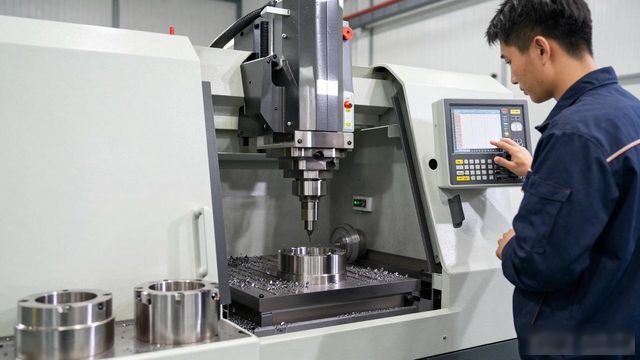
In view of advances in science and technology, many companies have purchasedCNC Milling MachineAlthough such modern CNC equipment is available, certain quality issues can arise during the machining process on CNC milling machines when production is actually underway. This article will examine these issues in the light of practical circumstances and analyse possible solutions to them.
In recent years, driven by rapid technological advancements, CNC machine tools have become increasingly widespread. Within the manufacturing sector, CNC machining has assumed an ever more significant role, with the vast majority of enterprises embracing this trend by purchasing modern CNC equipment such as CNC milling machines. However, in actual production, problems frequently arise during CNC milling operations, resulting in workpieces that lack sufficient precision, orsurface qualityThis results in poor quality, leading to the need for rework or even the scrapping of workpieces. The causes of these issues often lie in substandard working environments, the need to improve operational management standards, the inappropriate selection of machine tools, and cutting processes. This article will examine common quality issues encountered in CNC milling operations.
Key Features of CNC Milling Machines
In addition to the features of conventional milling machines, CNC milling machines also offer the following functional characteristics:
1. During the precision grinding of components, the process offers exceptional flexibility and adaptability, enabling the machining of parts with highly complex contours and difficult-to-control dimensions, such as housing components and moulds.
1. Parts that are difficult to machine on a conventional milling machine can be processed effectively on a CNC milling machine; this is particularly true of parts with three-dimensional curved surfaces.
1.3. Parts requiring multiple processing steps can be machined
1.4. When it comes to machining parts, the precision requirements are extremely high, and the quality is reliable, thereby eliminating the operational errors that can occur when using conventional milling machines.
1. In terms of production management automation, the high level of automation significantly reduces the workload for operators, which is highly beneficial.

1.6. Part machining efficiency is extremely high; no specialised fixtures or other dedicated process equipment are required during machining. When changing workpieces, it is sufficient to run the machining programme stored in the system, adjust the tool data and clamp the tool, thereby significantly reducing production lead times. Furthermore, CNC milling machines incorporate the functions of boring, milling and drilling machines, allowing for the consolidation of machining operations and thereby significantly improving production efficiency. To facilitate the selection of optimal cutting parameters, both the feed rate and spindle speed of CNC milling machines feature stepless speed variation.
Analysis of Quality Issues in CNC Milling and Related Measures
2.1. The machined surface is uneven and rough
During the machining of parts on a CNC milling machine, the finishing of flat surfaces is a critical and frequently performed operation that demands a high standard of surface quality. However, in practice, the resulting surfaces are sometimes uneven and rough, failing to meet the specified requirements.
The main cause of this problem is that, during finishing operations, the feed rate is too high; consequently, the vibrations generated by the rapid movement of the cutting tool are highly likely to leave an uneven finish on the machined surface. To avoid this problem, it is best to set the F-value for face milling finishing below /min and set the spindle speed to /min, In addition, there is another issue: when finishing the surface, there may occasionally be discrepancies between the tool marks of two adjacent toolpaths. This is caused by inconsistencies in the direction of the tool’s cut. To avoid this problem, a full-feed milling approach should be adopted.
2.2. The tool marks on the side surfaces are too prominent after fine milling
In the machining of workpieces on CNC milling machines, almost every workpiece requires precision milling of its sides. However, it is often the case that the tool marks left on the sides after precision milling are too prominent. This is absolutely unacceptable, as it seriously compromises the appearance of the workpiece.
The primary causes of this issue lie in the incorrect selection of the tool entry and exit points, inappropriate parameter settings, and cutting in Z-depth layers. There is a wide variety of machining software available, and whilst the milling methods offered by different programmes vary, they all provide options for selecting cutting depth as well as entry and exit parameters. To avoid the issues mentioned above, adjustments can be made in three key areas. Firstly, the entry point must be selected correctly; it should be at the very edge rather than in the centre, and the exit point must not be on the same side. Secondly, if it is essential to start machining from the centre, an overlap of approximately 3 to 5 mm should be added during both the approach and retract phases. Thirdly, when performing side finishing, it is best to use full-depth machining.
2.3. Tool change marks during finish milling
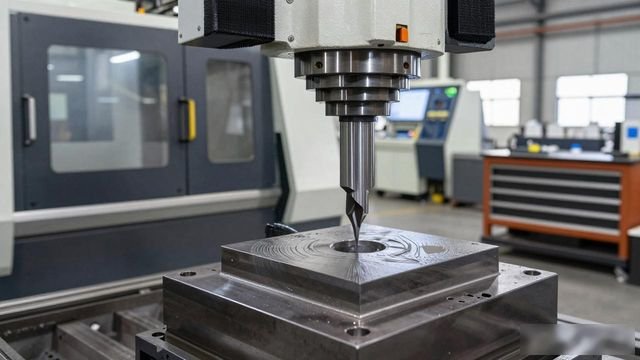
Tool changes are necessary during standard machining processes, particularly when high-speed machining is involved. However, if the relevant parameters are not adjusted during a tool change, this can result in noticeable marks, which in turn can seriously affect the appearance of the workpiece.
When performing finish milling on a base or side surface, tool marks are a common occurrence. In many cases, people tend to regard this as an unavoidable error; however, it can in fact be completely avoided. To resolve this issue, simply add a positive Z-axis allowance of 0.005 to 0.015 mm in the programme. During machining, when creating a finishing programme for recessed corners, a smaller cutting tool must be used. Given that the workpiece may wobble under the force of machining, tool marks are highly likely to appear at these corners. To resolve this issue, an appropriate allowance of 0.01 to 0.02 mm should be added to the X and Y axes.
2.4. Burrs or flash remain on the surface or sides after finishing
In modern machining, surface finish requirements are becoming increasingly stringent, and the presence of burrs or flash is simply unacceptable. If a file is used to correct the workpiece, this may compromise its precision and dimensions; therefore, it is preferable to use the workpiece directly after milling, without the need for subsequent grinding. However, in actual production, a significant amount of burrs and flash still remain.
To resolve this issue, the utmost care must be taken with the cutting tools; specialised tools must be used to ensure they are extremely sharp during machining. In addition, care must be taken in planning the toolpaths, incorporating a secondary finishing pass. This involves machining the top surface first, followed by the side, and then the top surface again. This ensures that no burrs or flash remain, which is particularly useful for workpieces that cannot be polished.
2.5. Finishing of workpieces with unusual shapes
When finishing workpieces with certain complex shapes, the software often produces fitting errors; if the calculated error is too large, this can cause the workpiece to deform, thereby affecting its appearance. To resolve this issue, it is necessary to address the problem at the software level by controlling the error. This is generally set to 0.001 mm, a value that is relatively reasonable as it neither affects calculation speed nor causes the workpiece to deform.
To achieve perfect machining results on a CNC milling machine, one must possess extensive experience and patience. Only by fully understanding all possible scenarios can one take the correct measures when problems arise. This ensures that workpieces produced by CNC milling machines are of excellent quality and significantly improves machining efficiency.
 Chinese
  Japanese
  English
  German
  Finnish
Leave a Reply
You must be logged in to post a comment.